
Helicoid Industries Inc. | Top Advanced Material Solution Company 2020

Helicoid Industries Inc.


Mr. Pascal Joubert des Ouches, President, Helicoid Industries Inc.Mr. Pascal Joubert des Ouches, President
Digital additive manufacturing is progressively reshaping the composite industry and driving manufacturing towards a more direct process rather than the former “roll’ approach. The composite industry has traditionally been based on weaving looms and multi-axial fabric machines producing rolls of fiber reinforcements. Even with software to assist in optimizing the net-shapes cut from these rolls, the final result still produces a significant amount of waste. While this process is efficient at making large volumes of fabric in roll form, conversion to the final product can ultimately generate 15% to 25% raw-material waste. Another limiting factor of this roll process is linked to the X / Y axis these machines can achieve. This limits the fibers to only 2 to 4 directions in most cases, (0°/90° or the typical 0°/+45°/-45°/90°) which results in a low-performing architecture. This results in less-flexible part-design and inferior strength characteristics for the final composite parts.

For the last two decades the advancement of robotic arms has progressed to allow the production of net-shape parts and direct printing of 3D parts, thus breaking from the old roll approach.

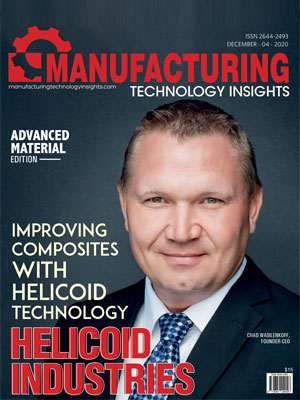
This evolution first appeared in robotic filament winding and is now widely used for pressure vessel manufacturing. Robots and their carbon fiber deposition heads have allowed the aerospace industry to drape large, complex structures which require sophisticated fiber orientations and thick fiber layups. Automated Fiber Placement (AFP) machines are more accurate and consistently achieve material waste rates below 5%. 3D printers are also robotic machines capable to print structural materials such as carbon fibers embedded in a thermoplastic matrix with improved speed and accuracy which further reduces waste. These digital additive manufacturing technics are extremely flexible allowing all kinds of fiber orientations and stacking complexity at minimal cost to optimize part design and performance. Within such manufacturing evolution context, Helicoid Industries is bringing to market a bio-inspired disruptive composite layup technology which boosts laminate impact performance. Helicoid Industries technology is now able to be cost-effectively implemented at commercial scale due to these improvements in manufacturing processes. Over the past decade, several research groups have focused on implementing this helicoidal-inspired composite structure aiming at exploiting the formidable toughening and damage resistance over conventional composite structures. The outstanding impact resistance comes from the ability of helicoidal microstructures in harnessing the damage process by promoting the formation of sub-critical damage in the form of matrix cracks that nucleate and nest in the volume of the material, thus delaying catastrophic failure. Helicoidal-inspired composites have now been successfully developed across a wide range of applications and material systems, showing improved performances in numerous loading and stress conditions. The advancements of digital additive manufacturing now enable this advanced architecture to be utilized and deliver solutions that enhance performance of all parts designed for toughness and impact resistance while allowing both weight and cost savings.

Share this Article:

Helicoid Industries Inc.

Company
Helicoid Industries Inc.

Management
Mr. Pascal Joubert des Ouches, President

Description

Helicoid Industries Inc. News

Bio-Inspired Lightweight EV Underbody Protection to Serve High Volume Commercial and Automotive Market Developed by Helicoid Industries Inc. and TPI Composites Inc.

Helicoid Industries, Inc. and TPI Composites, Inc., (TPI) (Nasdaq: TPIC) have collaborated to design a bio-inspired lightweight EV underbody protection panel using Helicoid™ technology. The solution leverages digital engineering, unconventional layup scenarios, biomimicry, advanced multiaxial intelligent weaving, and automated manufacturing to deliver a durable, low-cost, highly engineered automotive part for the commercial and consumer automotive markets.

INDIO - Helicoid Industries, Inc. and TPI Composites, Inc., (TPI) (Nasdaq: TPIC) have collaborated to design a bio-inspired lightweight EV underbody protection panel using Helicoid™ technology. The solution leverages digital engineering, unconventional layup scenarios, biomimicry, advanced multiaxial intelligent weaving, and automated manufacturing to deliver a durable, low-cost, highly engineered automotive part for the commercial and consumer automotive markets.

This underbody protection panel will provide an alternative solution to current aluminum designs to protect high voltage battery packs from road debris. Combining the strength of both companies, this solution offers a low-cost product that is lower in weight, higher in load bearing capability and more resilient in impacts and crash scenarios compared to aluminum designs.

Chadwick Wasilenkoff, CEO, Helicoid Industries states “We are excited to collaborate with such a strong partner as TPI on a market segment that is experiencing significant growth. Protective crash boxes and skid plates for the growing electric vehicle market represent a significant opportunity for Helicoid. With the ability of our technology to deliver a lighter, safer, and more cost-effective solution paired with the confidence and credibility that TPI brings to our technology, we have found a winning solution.“

Developed in a manufacturing cell at TPI’s Automotive Technology Center in Warren, Rhode Island using the latest in automated ply cutting and robotic pick and place technologies, the process is a seamless and cost-effective implementation of Helicoid™ architectures. A multiaxial non-crimp fabric technology is used to strategically compose the full Helicoid™ stack in sub-units. The stack layers are then robotically dosed and automatically placed and retrieved from a 2500T press, resulting in high performance precision parts.

Jerry Lavine, President of TPI Automotive noted, “TPI Automotive offers full-service development and production solutions for OEM next generation vehicles with efficient designs, superior performance, and outstanding quality. We offer industrialization expertise for engineered solutions that are quick to market, and low investment for our customers’ demanding technical and commercial battery enclosure and structural applications. We are excited to work with Helicoid to provide this innovative solution.”